Showing posts with label books. Show all posts

Sunday, July 25, 2010

Oxford

The United Kingdom as a whole is roughly the size of Oregon. This is one of the things I had a hard time getting used to: how very close everything is. The entire trip between Lacock and Oxford, including waiting*, took about an hour or so. It was no big deal for us to hop on the bus and make several train connections to get to Oxford.

We arrived at Oxford in a chaos of tourists. School groups and tour groups jammed the heart of the city. Trying to move through the crowds sometimes felt like slogging through molasses. 

Oxford-06
 There were lots of Oxford students out and about, most in academic dress of some kind or other. Some students were wearing short robes with strange flaps of fabric dangling off the shoulders. According to wikipedia, these are "streamers adorned with folds," and are worn by undergraduates.  Academic dress or not, they still looked funny, as if the undergraduates had sprouted extra arms.

Oxford-20
The wildlife of Oxford
There were also schoolchildren in their uniforms. While we were waiting to cross at an intersection, we saw a schoolgirl walk by with artfully ripped tights. The group of schoolgirls next us started whispering furiously about her audacity.

Oxford-28
We got our first proper tea at The Grand Cafe, site of the first coffeehouse in England.  The art deco interior was dazzling, due to an abundance of gold leaf and enormous floor to ceiling windows.

Oxford-08
I got a kick out of the counterweight for the door, a teapot.  
The cafe was lit by lamps held aloft by arms sprouting from the walls.  They were eeriely similar to the arms in Jean Cocteau's 1946 movie La Belle et la Bete.  I kept expecting an arm to move, or the Beast himself to emerge from a hidden door, or out of one of those outlandishly huge mirrors.  My kind of place!

Tea itself was scrumptious.  A pot of steaming black tea, an overflowing sugar bowl (the British love their sugar), rich cream, and duchess cake, an intriguing mix of fudge, dried fruit, and nuts.  I truly settled into England after this tea.

In front of the Bodleian Library, Oxford
Of course, we took a tour of the Bodleian Library. Our group waited for the guide inside the Divinity School, the oldest university building, built between 1427-1483.

Oxford-16
Harry Potter was here
While building stone doesn't quite have the air of nature, I felt as if we were in a light-dappled glade. Such is the effect of light and airy Gothic architecture, and the skill of stonemasons from over 500 years ago. The columns were trees leaning over us, spreading a lattice-work of branches overhead in the form of lierne vaulting.
 

I wish I could have a painted ceiling like this
We visited Duke Humphrey's medieval library.  Books were not allowed to leave the room, not even for the king.  He had a screened in alcove where he could read books in private without commoners gawking at him.  There were also chained books, an early security measure in a time when books were extremely valuable.

After the Bodleian Library, we went to the TIC** and asked for directions to Tolkien's house.  At first, we were greeted with a blank stare by the first employee we asked.  After consultation with the entire staff, another employee came to the rescue and gave us directions***.

J.R.R. Tolkien's house in Oxford
Tolkien's house is located in a very lovely suburb of Oxford, full of rambling old houses with arched windows, beautiful stonework, and windows full of happy plants.  The house itself wasn't one of the nicer houses, but, nonetheless, it is notable for containing the drawing room where Tolkien wrote The Hobbit and The Lord of the Rings.

Oxford-26
After this satisfying stroll away from the crowd of tourists, during which we noted that Tolkien had most likely walked the same route countless times, we headed to the Eagle & Child pub, where the Inklings used to meet and discuss their current literary endeavors.

Rabbit Room at the Eagle & Child pub in Oxford
The usual place for their meetings was in the Rabbit Room, but people were sitting there when we arrived, so we ended up sitting in the enclosed conservatory in the back.  The bartenders recommended the nachos (I thought this was funny for some reason - nachos in England?), and we had some of the best beer of our trip there.  J. went to the bathroom and told me he went into a room where Tolkien has been, but where I can never go.

Oxford-30
This tree looks like it is about to eat me
We walked along the Thames path and marveled at the many specimens of giant trees along the way.

Oxford-31
Various rowing clubs were practicing on the Thames.  Once they got going, they really flew down the river.

Oxford-33
We ate at Chequers pub for dinner.  I got to try a "ploughman's lunch," which usually consists of cheese, bread, fruit, salad, chutney, and a petite meatpie.  The cider I got here was the best cider I've ever had, Aspall Draught Suffolk Cyder, produced by Aspall Cyder.  Not cloyingly sweet, it had a pleasing floral note with a satisfying finish that put one in mind of the barnyard--an interesting mix of sweet hay and musky animal scents.  My description probably makes it sound unappealing, but you'll know where I'm coming from once you have a sip of this exquisite cider.

We returned to Damson Cottage pleasantly exhausted.  A chorus of baa's sang down the moon that night as we startled sheep lining the path between Lacock and Reybridge.

*See first footnote of post "And so it begins"
**"Tourist Information Center"-invaluable sources of information while traveling in the United Kingdom 
***If you're curious, the address is 20 Northmoor Road, Oxford

Saturday, March 27, 2010

Monday, March 01, 2010

A picture is worth a thousand words

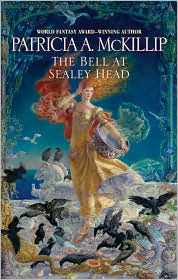
Occasionally my decision to pick up a book is based solely on the cover art.

The cover art for "The Bell at Sealey Head" is redolent with story.  My curiosity was piqued, and the book did not let me down.

Tuesday, February 23, 2010

2000 years in 3 months

I have finished reading Rebecca Fraser's excellent book "The story of Britain: from the Romans to the present."

I am bereft.  What will I read on my Saturday mornings?

Saturday, February 20, 2010

How many hobbits can there be?

 
Just found a delightful website containing a collection of all the incarnations of the book "The Hobbit."  Visit Babel Hobbit to discover more.

Monday, January 11, 2010

History of a nation


While it's a door-stopper of a book that, "if thrown with a good over arm action, [would] bring a water buffalo to its knees*," Rebecca Fraser's The Story of Britain has been a pure delight to read, even if I'm only able to retain about a tenth of the information that I've read so far (I'm already planning to read it through again).  She has accomplished the seemingly impossible: condensed 2,000 years of British history into an entertaining, thoughtful, and well-written book.

Check out the image of Britain covered in snow, taken by NASA's Terra satellite.  Startlingly beautiful.

*from Nancy Banks-Smith's review of M.M. Kaye's "The Far Pavilions"

Sunday, January 03, 2010

Books of 2009

I read about 60 books last year.  Not as nearly much as I did for the year 2008 (see this post It's always books), but it's been a year of changes and adjustments (new job, new house) so I don't feel too bad about that.  At least I was still able to read some.

Some highlights from my reading for 2009:

The Magician's Book: a Skeptic's Adventures in Narnia - a fresh view of the series and doubly interesting as it was written from a non-Christian perspective
A Homemade Life: Stories and Recipes from my Kitchen Table - good food is an integral part of everyday life; blend of essays and recipes
The Sweetness at the Bottom of the Pie - you'll be charmed by the protagonist of this quirky mystery, an 11 year old aspiring chemist who lives in a ramshackle country estate in England
Spirit and Flesh: Life in a Fundamentalist Baptist Church - a sociologist studies the life of a church for over 20 years - fascinating insights into the mindset of fundamentalist christians
The Physick Book of Deliverance Dane - an academic mystery that manages to be engrossing, despite inordinate amounts of time spent in the library; interesting depiction of colonial America
An Elegant Madness: High Society in Regency England - it's always amazing to learn what the worldview of people was at a certain point in history, not to mention that this was the period that Jane Austen lived in

Wednesday, November 11, 2009

Dumbledore's portrait

One of the saddest passages in all of the Harry Potter books:

"And a new portrait had joined the ranks of the dead headmasters and headmistresses of Hogwarts: Dumbledore was slumbering in a golden frame over the desk, his half-moon spectacles perched upon his crooked nose, looking peaceful and untroubled."--from "Harry Potter and the Half-Blood Prince" (penultimate book in the series)

Thursday, October 22, 2009

Importance of research


Research for our trip to Scotland and England

Getting to know your own library


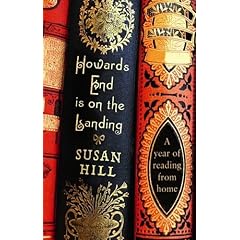
From Susan Hill’s new book Howards End Is On the Landing:

"It began like this. I went to the shelves on the landing to look for a book I knew was there. It was not. But plenty of others were and among them I noticed at least a dozen I realised I had never read.

I pursued the elusive book through several rooms and did not find it in any of them, but each time I did find at least a dozen, perhaps two dozen, perhaps two hundred, that I had never read.

And then I picked out a book I had read but had forgotten I owned. And another and another. After that came the books I had read, knew I owned and realised that I wanted to read again.

I found the book I was looking for in the end, but by then it had become far more than a book. It marked the start of a journey through my own library.

I really should do something like this. I don't think I've read even a quarter of the books I own...and yet I still check books out from the library."


Wednesday, October 21, 2009

Knowledge and the wild things


I had a very strange dream a couple nights ago. It was amusing, bizarre, and beautiful in the way that only dreams can be. It illustrates how dreams can be the brain's creative way of sorting through all the information we cram into it, consciously or subconsciously.

I dreamt that the wild things were the caretakers of the trees of knowledge. All I remember of the dream is this: I am deep in the bowels of what I initially think is the earth, yet I soon realize that we are in a different place, like the Wood between the Worlds from the Narnia books. We are in a cavernous space, looking up at the giant roots of trees, pushing through the ceiling. They are unbelievably large, like mountains, beyond the scale of comprehension, and I feel impossibly small while looking up at them. This sense of scale does not bother me.

As is the way of dreams, I never see the wild things, though I know they are present. While it’s funny that the creatures from Sendak’s book “Where the Wild Things Are” should show up in my dream, as the caretakers of these ponderous trees, no less!, somehow they added a sense of gravitas to my dream. Their wildness meant they were dangerous, and I should take care in this place where the trees of knowledge reside.

I never find out what the wild things do to trespassers. All I am left with is the image of those giant roots suspended in a vast space, and the profound sense of awe I felt while gazing at those ponderous roots far above me, and a niggling sense of foreboding, an intuition that I should not tarry long in this place, no matter how heartbreakingly beautiful the trees are.

And that was the dream. There's no hidden meaning behind it, no suppressed emotions trying to get out. Just the hint of a story.

I like those kinds of dreams.

Wednesday, August 12, 2009

Why we speak

Another quote from "Albion":

"The mark or symbol of the hawthorn tree is to be found in the runic alphabet of the ancient British tribes, as if the landscape propelled them into speech."--p. 3

To speak is to name. To name is to know--to make known. Alternatively, to be spoken to is to be known. I never feel like I know a child until she begins to talk to me. From the moment my friend's little girl called me by name and began to chatter away, it was like a door opening into a hallway filled with more doors into more rooms. She was like a seed planted in the earth, and when I returned to check on it, I found a tree antlered with many branches and crowned with many leaves.

If you were mute, and saw a tree--one of those remarkably old trees, like the redwoods in California or the squat dreaming oaks in England--would you be compelled to speak?

Roots and fingers

I knew that I would like "Albion: the Origins of the English Imagination" when I opened the book to the first chapter and saw that it was titled, simply, "Tree." As is obvious from the subtitle, the book seeks to investigate the varied and rich history of the English imagination. The following quote illustrates why the ever important first chapter of this hefty, door-stopper of a book is devoted to trees:

"The tree encloses a communal memory--'beyond the memory of anyone now living', as the medieval rubric was later to express it--and from it derives that sense of place, of literal rootedness, which is one of the great themes of the English imagination."--p. 5-6

It never fails to amaze me how language boosts our understanding of the world. It's one thing to flatly state that the English have a sense of place; it's another to use the image of a tree to illustrate how strong that sense of place is. As you contemplate the image of the tree, your fingers feel the grip of the roots on the soil as they work their way deeper in, ever deeper.

Sunday, August 09, 2009

Thursday, July 30, 2009

Treebeard as an ancestor

The latest "What Middle Earth character are you?" quiz on facebook informs me that I am an Ent. Even I was surprised, expecting as I was to be labeled a "Gondorian," seeing as I am not elegant as an elf, nor short and pleasant as a hobbit, or ugly as an orc.

Since I don't talk or do much, perhaps this is a very appropriate character to take after.

Wednesday, June 24, 2009

What's past is past

Things we've done lately:

  • cooked hobo sandwiches in embers from J.'s perpetual woodburning in the back (we have a pile of deadwood to get rid of)
  • planted coneflowers, coreoposis, asters, bee balm, and "oranges and cream" (not sure what the real name is)
  • painted the living room
  • saw the movie "Up," which is really, really good
  • shared a pasta arrabiata dish and chocolate souffle at Bella Notte
  • watched the cats pounce each other
  • competed in a bike race in the Red River Gorge (where J. was disqualified for doing something that protected him and the other riders: classic case of disobeying the letter of the law, but fulfilling the spirit of the law)

Monday, June 15, 2009

Books in time

I tend to have odd associations between places I've been and the books I was reading while I was in those places.

Most recently, when Jon and I were getting onto the interstate after a time trial just outside Shelbyville, KY, I had an intense recollection of Neil Gaiman's American Gods, which I had been reading the last time we were in Shelbyville for a bike race. We were on the merge lane, a scrappy bit of pavement with humps of broken asphalt littering the shoulder. I glanced at the grass and scrubby bushes bordering the lane, and the black and green cover of American Gods popped to mind, down to the part of the book I had been in the last time we were on this merge lane (the protoganist had died and was making his way through the underworld before being called back).

Here are some other associations I have:

Whenever I pick up my tattered, yellowed 1970s paperback copy of The Fellowship of the Ring, I am mindful of my parents' family room: the beige walls, nubby carpet, couch with the faintly plaid pattern. The window by the couch is covered with green ivy, and what light comes through is pale, weak with rain.

Harry Potter and the Deathly Hallows goes hand in hand with our old living room from South Broadway Park. I remember tracking the progress of the sunlight across the hardwood floor every time I looked up from the book when I was reading it for the first time, and so this book comes with connotations of hardwood warmed with light, patterned by the shadows of leaves.

That's all I can remember for now. Until I pick up the next book.

Thursday, May 28, 2009

Food and bookcovers


I've just finished reading Molly Wizenberg's A Homemade Life: Stories and Recipes from my Kitchen Table, and am determined to try out some of the recipes she includes. First up is "Doron's Turkey Meatballs with Golden Raisins and Pine Nuts," which you can see for yourself at her blog Orangette, which is the basis for this book.

This is a thoroughly domestic book. A little bit of memoir (no navel-gazing, d., thankfully) leavens this book about food and eating, with a collection of recipes that span the thoroughly homey (potato salad) to the truly unique (salad with chocolate). The cover alone caught my eye (how you can resist such a charming lineup of teacups and glassware?), but the writing snared me.

J.'s mom asked how I find such interesting books. For this one, I came across it using Amazon's "Customers who bought this item also bought..." feature while looking up another book, Made from Scratch: Discovering the Pleasures of a Handmade Life.